This checklist provides an overview of the technical requirements within the Enterprise Green Communities Criteria.
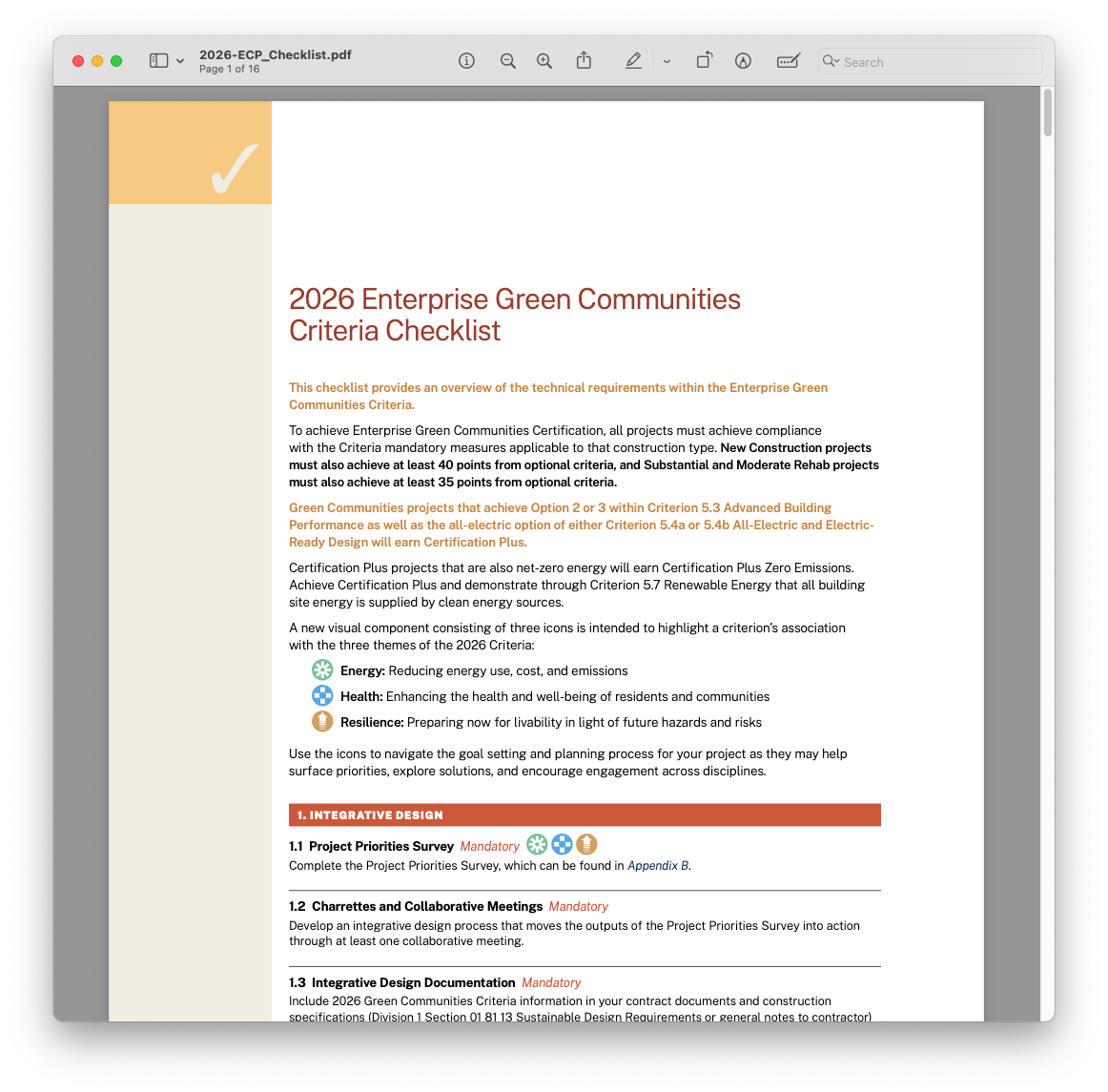
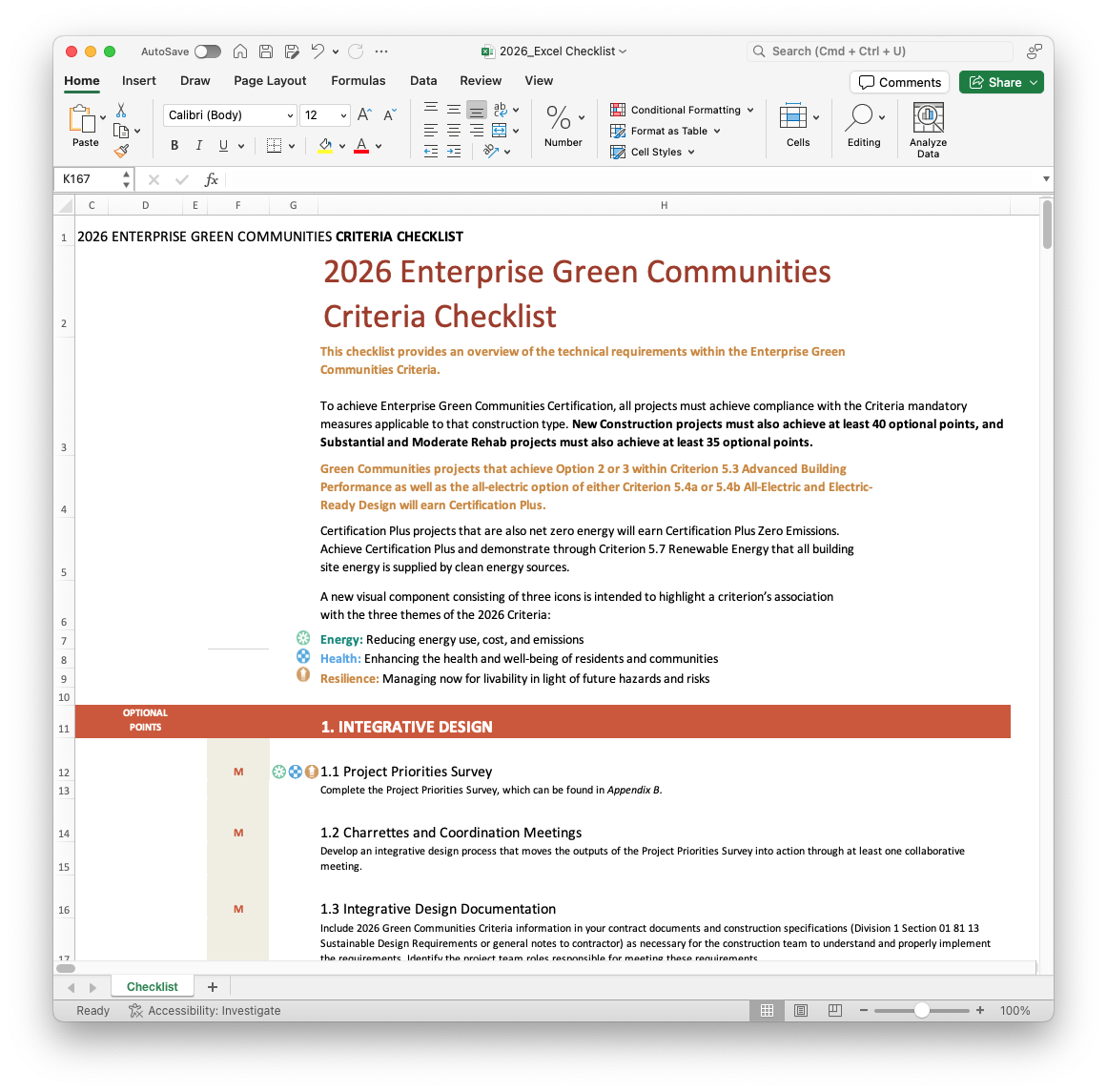
To achieve Enterprise Green Communities Certification, all projects must achieve compliance with the Criteria mandatory measures applicable to that construction type. New Construction projects must also achieve at least 40 points from optional criteria, and Substantial and Moderate Rehab projects must also achieve at least 35 points from optional criteria.
Green Communities projects that achieve Option 2 or 3 within Criterion 5.3 Advanced Building Performance as well as the all-electric option of either Criterion 5.4a or 5.4b All-Electric and Electric-Ready Design will earn Certification Plus.
Certification Plus projects that are also net-zero energy will earn Certification Plus Zero Emissions. Achieve Certification Plus and demonstrate through Criterion 5.7 Renewable Energy that all building site energy is supplied by clean energy sources.
A new visual component consisting of three icons is intended to highlight a criterion’s association with the three themes of the 2026 Criteria:
Energy: Reducing energy use, cost, and emissions
Health: Enhancing the health and well-being of residents and communities
Resilience: Preparing now for livability in light of future hazards and risks
Use the icons to navigate the goal setting and planning process for your project as they may help surface priorities, explore solutions, and encourage engagement across disciplines.
1.1 Project Priorities Survey
1.2 Charrettes and Collaborative Meetings
1.3 Integrative Design Documentation
1.4 Construction Management
1.5 Adaptive Planning for Resilient Communities
1.6 Design for Health and Well-Being: Health Action Plan
1.7 Inclusive Community Engagement
OR
Option 2: Convene a Cultural Advisory Group [8 points]
2.1 Ecological Conservation and Safer Sites
- Prevent new development within the 100-year floodplain of a Special Flood Hazard Area (new construction) or maintain/improve floodplain resilience (rehabilitation).
- Conserve and protect floodplains and all aquatic ecosystems during construction and operation.
- Avoid development in habitats for plant and animal species identified as threatened or endangered.
2.2 Connections to Existing Development and Infrastructure
2.3 Compact Development
2.4 Proximity to Services and Community Resources
2.5 Access to Open Space
OR
Option 2: On-site open space: Set aside a percentage [20%: 2 points; 35%: 4 points; 45%: 6 points] of the total project acreage as permanent open space accessible to all residents, at least 80% of which must be non-paved. For projects in urban or suburban settings, at least 20% of the permanent open space must include tree canopy or other shading.
2.6 Transit, Mobility, and Walkability
Mandatory: New Construction projects NOT in Rural/Tribal/Small Town: Locate projects within a 0.5-mile walk distance of transit services (bus, rail, and/or ferry) that, combined, provide at least 45 transit rides per weekday and include service on both Saturdays and Sundays. OR Implement any two strategies from the listed options for shared mobility initiatives, increased bikeability, and increased walkability.
Optional: Rehabilitation Projects NOT in Rural/Tribal/Small Town: Locate projects within a 0.5-mile walk distance of transit services (bus, rail, and/or ferry) that, combined, provide at least 45 transit rides per weekday and include service on both Saturdays and Sundays. [6 points]
Optional: All Projects in Rural/Tribal/Small Town: Any/all of the options here will earn 6 points. Projects within a 1-mile walk distance of public transit services (bus, rail, and/or ferry) that, combined, provide at least 45 or more transit rides per weekday and includes service on both Saturdays and Sundays, OR, Locate the project within 5 miles of one of the following transit options: 1) vehicle-share program; 2) dial-a-ride program; 3) employer vanpool; 4) park-and-ride; 5) public–private regional transportation. [6 points]
Optional: All projects: Implement any two strategies from the three strategies lists provided — Shared mobility initiatives, Increased bikeability, and Increased walkability. [1 point each for 6 points maximum]
2.7 Access to Fresh, Local Foods
2.8 Community Space and Programs
2.9 Access to Broadband
Mandatory: Multifamily projects with shared common space for which 100/20 fixed broadband is available to the parcel: Provide broadband internet access with at least a speed of 100/20 to at least one shared common space.
Mandatory: Multifamily projects for which 100/20 fixed broadband is not available to the parcel: Design and build or retrofit the property to incorporate broadband infrastructure so the property can be easily connected when broadband service comes to the parcel. Include a network of conduits throughout the building, extending from the expected communications access point to each network termination point in the building.
Optional: All projects: Provide broadband internet access with at least a speed of 100/20 to each common amenity space AND to each home in the property. [6 points]
2.10 Adaptive Reuse of Buildings
3.1 Minimization of Disturbance During Staging and Construction
3.2 Site Design for Ecosystem Services
3.3 Exterior Lighting
3.4 Surface Stormwater Management
Mandatory: All New Construction projects and any Rehab projects if land disturbed is ≥ 5,000 ft2: For sites measuring 1 acre or smaller, retain on-site precipitation equivalent to the 60th percentile precipitation event. For sites greater than 1 acre, retain to the 80th percentile precipitation event. Where not feasible due to geotechnical issues, soil conditions, or the size of the site, treat or retain the maximum volume possible.
Optional: All projects: Using low-impact development and green infrastructure strategies, retain precipitation volume from 85th percentile precipitation event [6 points], 90th percentile precipitation event [8 points], or 95th percentile precipitation event [10 points].
3.5 Outdoor Water Use: Efficient Irrigation
3.6 Outdoor Water Use: Alternative Sources
3.7 Traffic Safety and Mobility
3.8 Heat-Island Management
3.9 Resilient Site Design: Wind
3.10 Resilient Site Design: Flood
OR
Option 2: Implement ALL of the following strategies from the U.S. Department of Housing and Urban Development’s Designing for Natural Hazards — A Resilience Guide for Builders & Developers: Volume 2 Water. 1) Wall Assembly: at least two guidance items; 2) Utilities & Mechanical Equipment: at least two guidance items; 3) Freeboard Elevation: at least one guidance item; AND 4) Connectors & Fasteners: all guidance items. [9 points]
OR
Option 3: Conduct floodproofing of lower floors. Locate at least one exit door, all central space-heating and water-heating equipment, and service disconnects above the design flood elevation (DFE). On plan sets, identify water entry points in basements and foundations to ensure renovations do not compromise the integrity of floodproof construction elements. [6 points]
3.11 Resilient Site Design: Wildfire
- Implement the series of strategies specified for Zone 0 (0 to 5 feet from each building) defensible space, roof assembly, eaves and soffits, and windows. [9 points]
- Also implement the series of strategies for Zone 1 (5 to 30 feet from each building) and Zone 2 (30 to 100 feet from each building) defensible space, vents, siding and cladding, decks, and balconies. [3 points]
4.1 Water-Conserving Fixtures
4.2 Advanced Water Conservation
OR
Meet one of the approved certification methods for WaterSense-labeled homes. [8 points]
4.3 Water Quality
Mandatory: Substantial Rehabs of buildings built before 1986: Replace all lead service lines. For all Multifamily buildings with either a cooling towner, a centralized hot water system, or 10+ stories: Develop and implement a Legionella water management program.
Optional: All other Rehabs: Replace all lead service lines. [8 points]
Optional: All projects: Test and remediate as indicated for lead, arsenic, nitrates, and coliform bacteria [2 points each].
4.4 Monitoring Water Consumption and Leaks
Option 1: Leak detection with automatic shutoff [6 points]
AND/OR
Option 2: Pre-rehabilitation leak assessment [6 points]
AND/OR
Option 3: Advanced water metering [2 points minimum, 1 point for each additional end use; 4 points max]
If Option 3 is achieved in addition to another option: 2 additional points.
New Construction and Substantial Rehab projects are REQUIRED to comply with this criterion.
If choosing Option 2, project shall also comply with Option 1 or Option 3.
If choosing Option 3, project shall comply as specified below.
Regardless of option selected, conduct pressure-loss tests and visual inspections to determine if there are leaks and fix any leaks found.
For projects with remote monitors, ensure that data contract is turned over to building management at completion of project.
Option 3 for NYC Properties: Install a device to separately monitor water consumption of each cold branch off the apartment line riser for each dwelling unit, or each cold water riser and the domestic hot water cold water feed for each building or each toilet that allows remote monitor readings; common laundry facilities; boiler makeup water; outdoor water consumption; and water consumption in any non-residential space. [6 points].
4.5 Efficient Plumbing Layout and Design
Option 1: Performance design path: Design the building’s distribution system using the 2023 IAPMO Water Demand Calculator. [6 points]
OR
Option 2: Certification design path: Certify the project to WaterSense Labeled Homes Version 2.0. [4 points]
OR
Option 3: Volumetric design path: Meet either a 0.5 gallon or 1.8 gallon storage limit as described. [2 points]
4.6 Indoor Water Efficiency: Nonpotable Water Reuse
4.7 Access to Potable Water During Emergencies
NYC Plumbing Code 614 states:
“Buildings that supply potable water from the public water main for dwelling units and sleeping units in Occupancy Groups I-1, R-1, R-2, and R-3 with the assistance of pumps shall provide additional fixtures that in an emergency when such pumps are inoperable are capable of supplying potable water from the public water main to the building utilizing only the available pressure from the public water main. Such fixtures shall comply with Sections 614.1.1 through 614.1.5.”
New Construction projects providing additional fixtures as described in NYC Plumbing Code 614 meet Option 1 of Criterion 4.7 as-of-right; no documentation is required.
5.1 Energy Planning
5.2a Building Performance: New Construction
5.2b Building Performance: Rehabilitation
- ERI option: score of 80 or less for each dwelling unit, with exceptions for some rehabs built before 1980.
- ASHRAE option: projected energy performance of completed buildings to meet, at minimum, ASHRAE 90.1-2013 using an energy model developed by a qualified energy services provider according to Appendix G of 90.1-2016.
- Alternative pathways listed for Colorado and California
AND
Ensure proper HVAC sizing and performance, dwelling unit compartmentalization, insulation installation, lighting, and appliances as indicated.
5.3 Advanced Building Performance
Option 1: Performance above mandatory requirement: Design and construct a building that is projected to be more energy efficient than required for the building type by the applicable mandatory building performance criterion (5.2a or 5.2b). Achieve an ERI of 5 lower than required by 5.2a or 5.2b OR 5% greater efficiency than required if following the ASHRAE path for 5.2a or 5.2b compliance. [5–10 points]
Additional 1 point for each additional 2-point decrease in ERI OR for each additional 1% greater efficiency if following the ASHRAE path.
OR
Option 2: Advanced building certification: Certify to DOE Efficient New Homes Program (formerly ZERH) [12 points], ENERGY STAR NextGen [12 points], Passive Housing International (PHI) certifications including Classic, Plus, Premium, LEB, and EnerPHit [16 points], Phius certifications including CORE, ZERO, and REVIVE [16 points].
OR
Option 3: Deep energy retrofit: Demonstrate significant savings via the ERI or ASHRAE pathway as compared to the requirements of 5.2b Building Performance: Rehabilitation. For Substantial Rehabs, either 1) ERI of 65 or less or 2) 15% greater efficiency than ASHRAE 90.1-2013 per Appendix G of 90.1-2016. For Moderate Rehabs, either 1) ERI of 75 or less or 2) 10% greater efficiency than ASHRAE 90.1-2013 per Appendix G of 90.1-2016. [14 points]
5.4a All-Electric & Electric-Ready Design: New Construction
Mandatory: All cooking equipment is powered by electricity AND all dwelling-unit systems for space heating and water heating are either electric or electric ready as described.
Optional: The project is all electric apart from emergency backup power. [15 points]
5.4b All-Electric and Electric-Ready Design: Rehabilitation
OR
Option 2: All-electric property: The project is all electric apart from emergency backup power. [15 points]
5.5 Peak Demand Control
OR
Option 2: Residential Demand Management: Adopt a voluntary or automatic control strategy for demand management of in-unit residential electrical loads. Provide evidence that 50% or more of residents are participating. [8 points]
5.6 Backup Power
OR
Option 2: Off-peak battery storage: Battery storage system capable of storing off-peak energy and a system to switch to battery backup when the electrical grid goes down. [10 points]
OR
Option 3: Generator: Generator(s) and appropriate exterior connections, available on as-needed basis. [8 points]
All New Construction REQUIRED to comply with this criterion, and in addition to the options specified above, may do so by meeting the following Option for 8 optional points:
Provide a 'Shelter in Place Area' consisting in one or more resident-accessible community rooms equal to 15 sf per bedroom that is wired to backup power and includes, at minimum:
- Backup power for heating, cooling, lighting, outlets, and WiFi
- Operable windows
- At least one accessible bathroom with potable water source
- Refrigerator space totaling at least 0.25 cubic feet per bedroom
5.7 Renewable Energy
Install or procure photovoltaic (PV) panels or an electricity-generating renewable energy source from
one of the following options. See full criterion for required amounts and sources.
Option 1: On-site and/or direct ownership of renewables: A) Purchase and install on-site PV [10 points] OR B) Install on-site PV [8 points] C) On-site geothermal [10 points] OR D) A or B with community solar. [11 points]
Option 2: Procurement of community renewable energy [8 points]
Option 3: Procurement of off-site renewable energy: Direct purchase [7 points] with potential to add [1 point] if time-matched or time-aligned and the potential to add [1 point] if from same e-grid region; OR Green-E certified RECs [7 points]
5.8 Electric Vehicle Charging
Mandatory: New Construction and Substantial Rehabs: For projects that include parking, at least one parking space on the site must be wired and installed with Level 2 electric vehicle supply equipment (EVSE). In addition, for projects with 20 or more parking spaces, at least 10% of the total number of parking spaces must either be EV capable, EV ready, or have Level 2 EVSE installed. All spaces may utilize an Automatic Load Management System (ALMS) to reduce the maximum required electrical capacity to each space.
Note exceptions for meeting this requirement associated with additional transformers and/or electrical service upgrades.
Optional: All projects: For projects with 40 or more parking spaces, install Level 2 EVSE in at least 5% of the total number of parking spaces on the site. [4 points]
OR
For projects with four or more parking spaces, provide Level 2 EV-capable or EV-ready spaces in more than 50% of the total number of spaces provided on site. [4 points]
In addition to the options listed above, NYC Projects can earn points in these ways:
- For projects with 1-39 parking spaces, install at least two Level 2 EVSE [1 point]
OR - Provide Level 2 EV-capable or EV-ready spaces in more than 20% of the total number of spaces on the site [1 point]
5.9 Passive Survivability
6.1 Product Category Screening
6.2 Reduction of Materials and Waste
6.3 Reduction of Lead Hazards in Pre-1978 Buildings
6.4 Advanced Material Selection
Mandatory: Adhesives and sealants, wet-applied interior; Flooring; Insulation; Paints and coatings, wet applied inside the air barrier; Wall coverings; Composite wood.
Optional: Exterior wall cladding [2 points]; Concrete [2 or 5 points]; Flooring [1–4 points]; Gypsum [2 points]; Insulation [3 or 5 points]; Paints and coatings, wet-applied interior [2 or 4 points]; Steel [3 or 4 points]; Composite wood [2 or 4 points]; Noncomposite wood [2 points], for a total of 31 points maximum.
6.5 Recycling Storage
All projects are required to comply with this criterion, and in addition to trash and recycling bins, must also provide dedicated organics (compost) collection in all waste storage areas, with containers sized and configured to meet DSNY organics-storage requirements.
Also, all NYC buildings must participate in the DSNY’s Curbside Composting program, as leaf and yard waste, food waste, and food-soiled paper separation from trash is mandatory citywide.
7.1 Clean Air: Radon Testing and Mitigation
7.2 Clean Air: Combustion Equipment
7.3 Clean Air: Garage Isolation and Vehicle Pollution Management
7.4 Clean Air: Smoke-Free Policy
7.5 Clean Air: Ventilation
- A local mechanical exhaust system in each kitchen per ASHRAE 62.2-2022 Sections 5 & 7. Review the full criterion for alternative strategies. [4 points if Moderate Rehabs]
- A local mechanical exhaust system in each bathroom per ASHRAE 62.2-2022 Sections 5 & 7. [4 points if Moderate Rehabs]
- A whole-house mechanical ventilation system per ASHRAE 62.2-2022 Sections 4 & 7, excluding section 4.2. [4 points if Moderate Rehabs]
For each multifamily building of four or more stories, install a mechanical ventilation system for all hallways and common spaces per ASHRAE 62.1-2022 [3 points if Moderate Rehab]
For all mechanical ventilation systems, follow the installation guidance in the full criterion.
7.6 Clean Air: Indoor Air Filtration
7.7 Clean Air: Enhanced IAQ
7.8 Managing Moisture: Dehumidification
7.9a Managing Moisture in the Building Enclosure: New Construction
Wall and roof systems: Provide water drainage away from walls, windows, and roofs by implementing the list of techniques.
Foundations: Properly install foundation drainage, moisture barriers, and waterproofing materials to reduce the migration of moisture.
7.9b Managing Moisture in the Building Enclosure: Rehabilitation
- Water stains or wet spots
- Musty odors
- Foundation cracks and evidence of seepage
- Roof leaks
- Plumbing leaks
- Condensation in attics, and in or around windows and doors
- Moisture damage near all envelope penetrations, including windows and doors; utility hookups; and mechanical, electrical, and plumbing systems
7.10 Managing Moisture: Bath, Kitchen, and Laundry Assemblies
Use materials that have durable, cleanable surfaces throughout bathrooms, kitchens, and laundry rooms.
Behind tub and shower enclosures, use moisture-resistant backing materials such as cement board, fiber-cement board, or equivalent.
7.11 Reducing Allergens and Disease Vectors: Integrated Pest Management
7.12a Sensory and Rest Friendly: Noise Reduction, New Construction
7.12b Sensory and Rest Friendly: Noise Reduction, Rehabilitation
Option 1: Outdoor noise assessment and abatement plan [3 points]
OR
Option 2: Outdoor noise abatement: Minimal [3 points] or advanced approach [4 points]
AND/OR
Option 3: Interior sources of noise: For bedroom party walls, use the guidance and verification methods in the ICC G2 – 2010 Guideline for Acoustics to mitigate the potential for sound leaks. Verify performance as acceptable/Grade B [3 points]; or preferred/Grade A [4 points].
7.13 Personal and Social Safety
7.14 Social Connection and Accessibility: Design for All Ages and Abilities
7.15 Access to Nature and Biophilic Design
7.16 Healing-Centered and Culturally Responsive Design
7.17 Active Design: Promoting Physical Activity
7.18 Place-Based Wealth Building
8.1 Building Operations & Maintenance (O&M) Manual and Plan
8.2 Emergency Management Manual
- A Building Readiness Report from the Enterprise Business Continuity Toolkit
- Communication plans and resources for staff and residents
- Contact information for property management, resident services, public utilities, and insurer(s)
- Building shutdown procedures
- A plan for regular testing of backup energy systems, if applicable
8.3 Resident Manual
8.4 Walk-Throughs and Orientations to Property Operation
8.5 Energy and Water Data Collection and Monitoring
Option 5: All projects receiving HPD subsidy must follow HPD's Benchmarking Protocol and will satisfy compliance with this criterion by granting Enterprise view access to the benchmarking data.
OR
Option 6: In addition to following HPD’s Benchmarking Protocol for compliance via Option 1, HPD subsidized projects may earn 4 optional points for agreeing to participate in HPD's enhanced project monitoring and evaluation.